Environmental Intelligence.
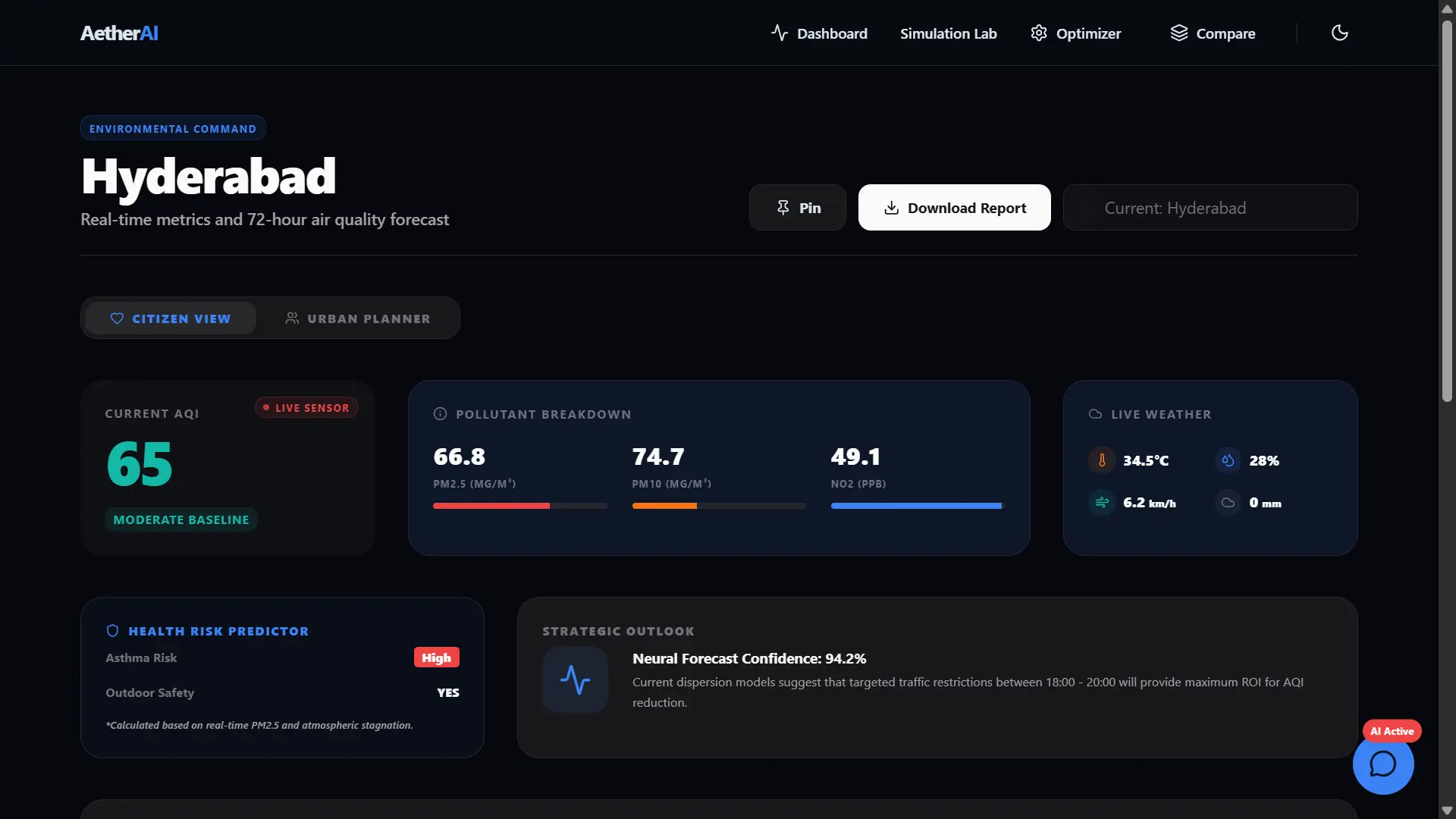
A next-generation environmental platform designed to bridge the gap between complex atmospheric data and actionable urban policy. AetherAI monitors real-time air quality, utilizes XGBoost to forecast 72-hour conditions, and leverages Google Gemini for strategic interventions.
The Vision
Environmental data is ubiquitous, but actionable intelligence is rare. Staring at raw AQI numbers or PM2.5 concentrations doesn't tell a user whether it's safe for their asthmatic child to play outside. I set out to bridge this gap.
AetherAI was built to be a proactive, intelligent environmental forecasting system. By fusing traditional machine learning (XGBoost) for high-accuracy numerical predictions with advanced LLMs (Gemini 1.5) for natural language translation, the platform transforms atmospheric data into personalized health strategies.
Engineering the Engine
Merging predictive analytics with generative AI required strict latency constraints and complex pipeline orchestration.
High-Speed Inference
Running ML inference in a web app usually introduces blocking delays. I built an asynchronous Python backend using FastAPI, aggressively optimizing the XGBoost model to execute 72-hour forecasts with an inference latency of less than 50ms per request.
Synthesizing Context
Raw predictions aren't enough. I integrated Gemini 1.5 Flash via streaming API to consume the numerical forecasts alongside user health profiles. The system generates real-time, context-aware mitigation strategies (like HVAC scheduling) without noticeable UI blocking.
Neural Architecture
Metrics from the forecasting and intelligence pipeline.