Building CampusPulse AI (Part 2): Student Portal, Dual-Persona Unification & End-to-End Verification
September 9, 2026 • 12 min read
Hook: During the integration phase of our IBM SkillsBuild learning plan project submission, our backend intelligence engine was purring, and the Admin Command Center had just been merged in PR #1. Then came Pull Request #2: a complete, beautiful student portal that created an
add/addmerge conflict across 10 frontend files. Facing our final submission milestone, we couldn't just overwrite either developer's code. We had to unify two distinct single-page applications into a single cohesive, dual-persona system.
In Part 1 of this series, we explored the foundational layer of CampusPulse AI: frozen API contracts, our Express + SQLite 3 architecture, the dual-tier resilient AI service, deterministic 4-factor correlation mathematics, and the merge of Pull Request #1 on September 8, 2026.
Here in Part 2, we cover the final phase of the project submission on September 9, 2026: building the student reporting portal, resolving the 10-file merge conflict, merging Pull Request #2 (65bb2ec), implementing the Raycast-style Universal Command Palette, executing our 19/19 automated test suite, and celebrating the 5-member engineering team that made it possible.
1. The Student Reporting Portal
While the backend and admin command center were taking shape on September 8, Developer 2 (Sreeshanth S) was independently engineering the Student Incident Reporting Portal (feature/student-ui).
Students reporting infrastructure failures require zero friction. If a reporting form feels like filling out government paperwork, students will continue complaining in WhatsApp groups instead of submitting actionable telemetry.
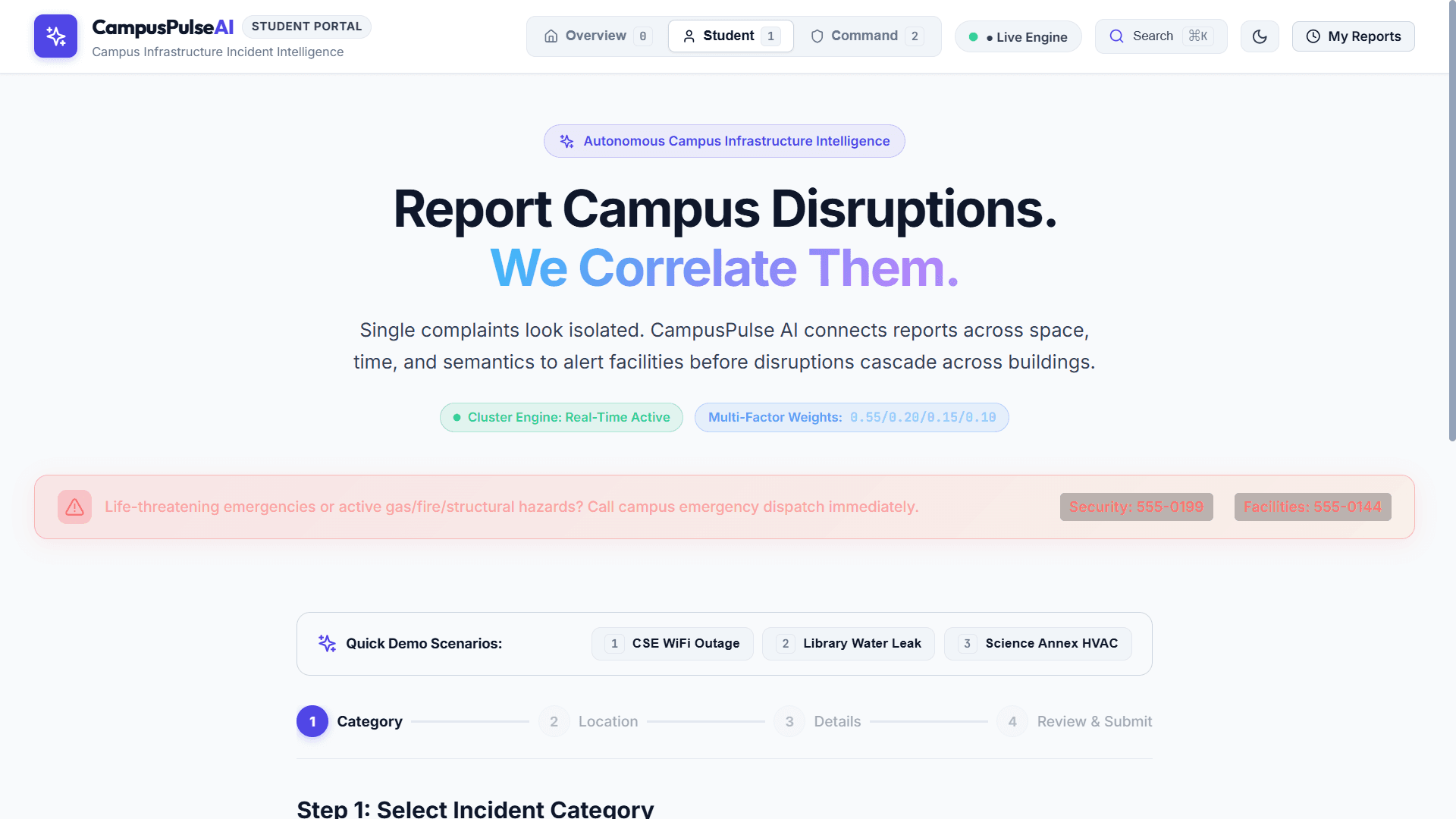
Key Capabilities of the Student Portal:
- Interactive Category Selector: High-contrast icon cards representing campus domains (
NETWORK,ELECTRICAL,PLUMBING,HVAC,PHYSICAL,EQUIPMENT,SAFETY,OTHER). - Preset Demo Buttons: One-click scenario chips ("CSE Block Lab 3 Wi-Fi Down", "Library 2nd Floor AC Leaking") enabling judges and users to immediately test correlation flows without typing paragraphs.
- Smart Location Suggestions: Real-time auto-suggest inputs mapped to campus buildings (
CSE Block,Mechanical Lab,Central Library,Admin Block,Science Annex) and rooms. - Instant Receipt & Tracking History: Client-side ticket receipt modal providing a copyable UUID ticket receipt, alongside local persistence via
localStorageso students can check the triage status of their previous reports.
2. The Gap Between PR #1 and PR #2: The 10-File Merge Conflict
On the morning of September 9, 2026 at 10:45, Developer 2 opened Pull Request #2 (feature/student-ui, commit 18e4057).
The Architectural Dilemma:
Because both Developer 2 (Student UI) and Developer 3 (Admin UI) had moved fast in parallel branches to meet the project submission milestone:
App.tsx: PR #1 hadApp.tsxrendering only theAdminDashboard. PR #2 hadApp.tsxrendering only theReportForm.services/api.ts: PR #1 had anApiClientconfigured for incident inspection and status mutations. PR #2 had an independentreportServiceconfigured for student submissions.index.css& Tokens: Both branches defined different root styles, color variables, and container layouts.- Types: Divergent client-side TypeScript definitions across 10 frontend files.
Overwriting either branch would wipe out an entire team member's work.
The Unification Strategy (Commits 4e8f41c & 65bb2ec):
Between 12:00 PM and 1:07 PM on September 9, 2026, our team resolved the merge conflicts by architecting a Unified Dual-Persona Role Switcher:
// App.tsx: Unifying Student and Admin Portals with Role Switching
export default function App() {
  const [activeRole, setActiveRole] = useState<'admin' | 'student' | 'landing'>('landing');

  return (
    <div className="min-h-screen bg-background text-secondary">
      <Navbar activeRole={activeRole} onRoleChange={setActiveRole} />

      <main className="container mx-auto px-4 py-8">
        {activeRole === 'landing' && <LandingPage onNavigate={setActiveRole} />}
        {activeRole === 'student' && <StudentPortal />}
        {activeRole === 'admin' && <AdminCommandCenter />}
      </main>

      <CommandPalette onSelectRole={setActiveRole} />
    </div>
  );
}
- Unified API Client: Merged
LiveApiClientandmockApi.tsso both portals seamlessly communicate with either the live Express backend or an offline mock adapter with instant toggle synchronization. - Merged PR #2 (
65bb2ec): At 13:07 on September 9, 2026, PR #2 was officially merged intomain, delivering a zero-regression, unified codebase.
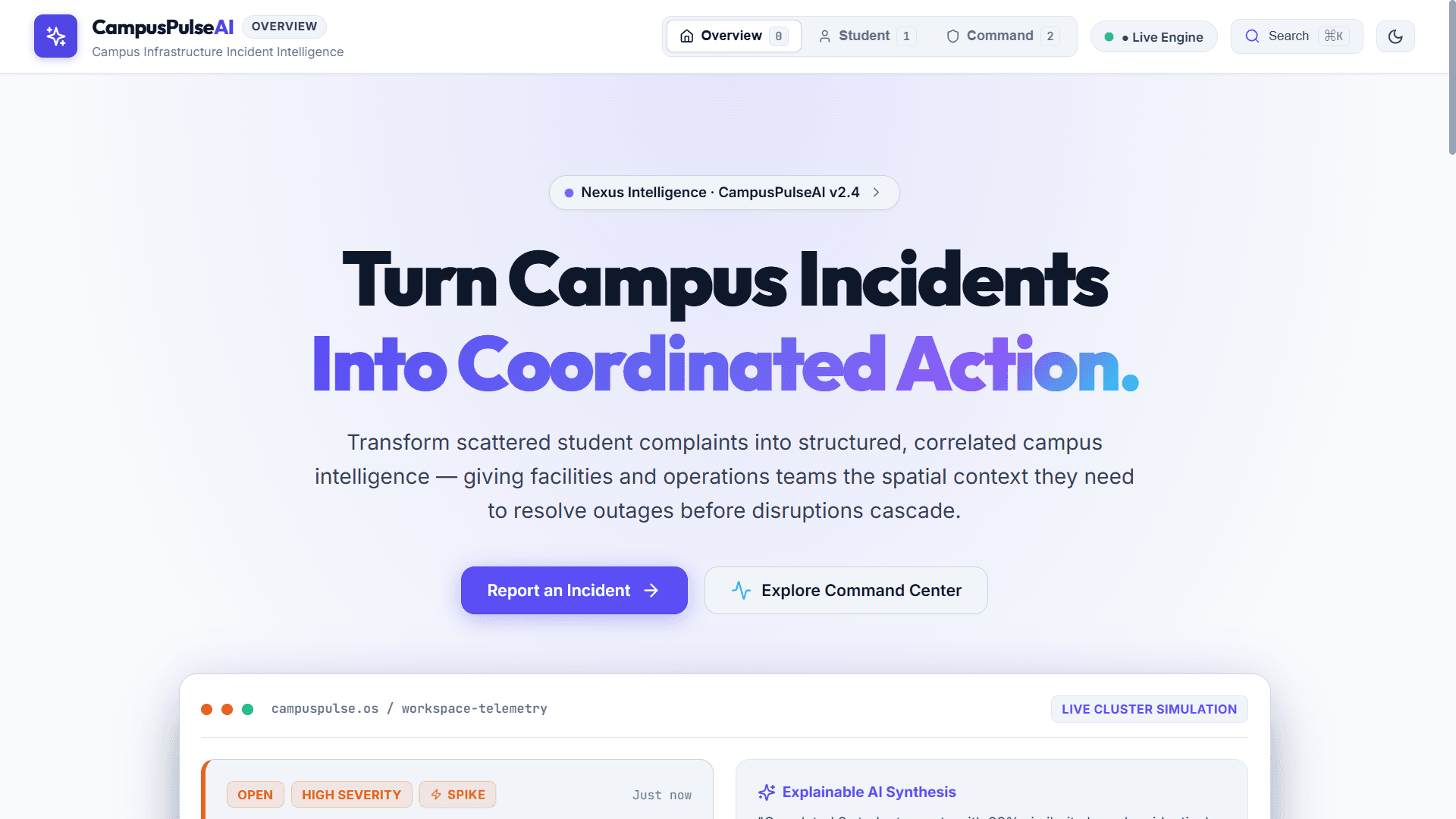
3. Universal Command Palette (Cmd+K) & SaaS UI Modernization
Following the PR #2 merge, our team focused on UI/UX modernization (commits 51d5874 and 681df40):
3.1 Raycast-Style Command Palette (Cmd+K / Ctrl+K)
We implemented a centered universal modal allowing campus administrators to navigate instantly:
- Jump between Admin Command Center, Student Portal, and Public Landing.
- Instant campus building filter (
CSE Block,Central Library,Mechanical Lab). - Quick-filter for Active Emerging Crises.
- Dark and Light Slate theme switching.
3.2 High-Density Startup SaaS Aesthetics
- Color Palette: Inspired by Linear and Nexus Workspace, using a
#5B4DF5violet-indigo primary accent, emerald active indicators, and crimson emerging crisis banners. - Subtle Glassmorphism:
backdrop-blur-mdpanels with semi-transparent surfaces (bg-surface/50) and crisp micro-borders (border-border/60).
4. End-to-End Verification, QA & Demo Script (Role 4)
A project submission is only as good as its live presentation. Co-owned by Sumanth Teju and Vaibhav Bharathula (Role 4: Integration, QA & Demo), our team created a fully reproducible, automated verification pipeline.
4.1 Canonical 6-Report Demo Dataset & CLI Seeder
We codified our live demonstration into demo-data/demo-scenario.json and built a one-line seeder:
npm run db:seed
The Canonical Demo Sequence:
- Report 1: "Wi-Fi is down in CSE Block Lab 3, can't submit assignment" → Creates anchor Incident: CSE Block Network Disruption.
- Report 2: "Internet disconnected in Room 204 CSE building" → Correlated with 82% match score.
- Report 3: "Cannot access campus Wi-Fi network anywhere on CSE 2nd floor" → Correlated; triggers Emerging Velocity Spike ($\ge 3$ reports in 60m), boosts impact score, and emits alert banner.
- Report 4: Unrelated "Water pipe leaking in Central Library 2nd floor" → Deterministic engine isolates report; creates separate Library Plumbing Incident.
4.2 Automated Test Runner (19/19 Passing)
We wrote automated unit and integration test suites executed by the Node.js native test runner (node:test, node:assert, tsx):
npm test
TAP version 13
# Subtest: API Integration Tests (8 tests)
  ok 1 - GET /api/health returns 200 OK and healthy status
  ok 2 - POST /api/reports with short description returns 400 validation error
  ok 3 - POST /api/reports with valid data creates report and anchor incident
  ok 4 - POST /api/reports with related complaint correlates into existing incident
  ok 5 - GET /api/incidents returns list containing the created incident
  ok 6 - GET /api/incidents/:id returns incident detail with reports and timeline
  ok 7 - PATCH /api/incidents/:id/status updates status and logs event
  ok 8 - GET /api/dashboard/stats returns aggregated KPI statistics
ok 1 - API Integration Tests

# Subtest: CorrelationEngine Unit Tests (7 tests)
  ok 1 - cosineSimilarity computes 1.0 for identical normalized vectors
  ok 2 - cosineSimilarity computes 0.0 for orthogonal vectors
  ok 3 - calculateLocationScore returns 1.0 for identical building
  ok 4 - calculateLocationScore returns 0.0 for completely different buildings
  ok 5 - calculateCategoryScore returns 1.0 for matching category
  ok 6 - calculateTemporalScore decays over time
  ok 7 - evaluateCorrelation produces expected score and explainability text
ok 2 - CorrelationEngine Unit Tests

# Subtest: SeverityCalculator Unit Tests (2 tests)
  ok 1 - Base impact score matches expected formula
  ok 2 - Emerging bonus adds +15 points
ok 3 - SeverityCalculator Unit Tests

# Subtest: EmergingDetector Unit Tests (2 tests)
  ok 1 - Reports spread out do not trigger emerging status
  ok 2 - 3 reports within 45 minutes triggers emerging status
ok 4 - EmergingDetector Unit Tests

# tests 19 | pass 19 | fail 0
5. Special Contributors & Team Ownership
Delivering a multi-tier AI application for the project submission required strict discipline, clear module ownership, and seamless cross-functional collaboration.
Our team was divided into 5 cross-functional engineering roles:
5-Member Cross-Functional Engineering Team
Decoupled micro-roles with frozen API contracts and parallel modular delivery.
Vaibhav Bharathula
Sreeshanth S
Vignesh Mandadapu
Sumanth Teju
Venkata Rohit
Cross-Functional Engineering (Vaibhav Bharathula): Spearheaded backend architecture and correlation math (Role 01), while co-leading full-stack integration, 19/19 automated test suite, and merge resolution (Role 04).
6. Key Takeaways & Lessons Learned
Reflecting on the journey of building CampusPulse AI for the IBM SkillsBuild learning plan project submission, three core lessons stand out:
- Contracts Prevent Merge Disasters: Freezing
shared/api-contract.mdearly allowed our frontend and backend teams to develop autonomously. Even when PR #1 and PR #2 collided inApp.tsx, the shared contracts meant the data contracts matched identically. - Deterministic Grounding Wins Over Pure LLMs: Using Gemini for fuzzy language extraction while keeping correlation math, impact scoring, and velocity spikes in deterministic code produced a system that was explainable, reproducible, and blazing fast.
- Resilience Is Non-Negotiable: Building an offline-ready
MockAIServicesaved us from API rate limits and network latency during live demonstrations.
Project Links & Series Navigation
- Read Part 1: Building CampusPulse AI (Part 1): Foundation, Multi-Factor Correlation & Admin Command Center
- GitHub Repository: https://github.com/Vaibhav-1819/CampusPulseAI.git
- Tech Stack: React 19, TypeScript, Vite, Node.js, Express, SQLite 3 (
better-sqlite3), Google Gemini 1.5 Flash (@google/generative-ai), Lucide Icons, Vanilla CSS Design System.
Check out the live code, run the demo seeder, or inspect the correlation engine math on our CampusPulseAI GitHub repository!